Anthropic IPO: Key Numbers From the Claude Maker's S-1
Anthropic filed to go public on Nasdaq as ANT. Here are the revenue, loss, compute deals and governance details from the S-1, and what happens next.

The short answer
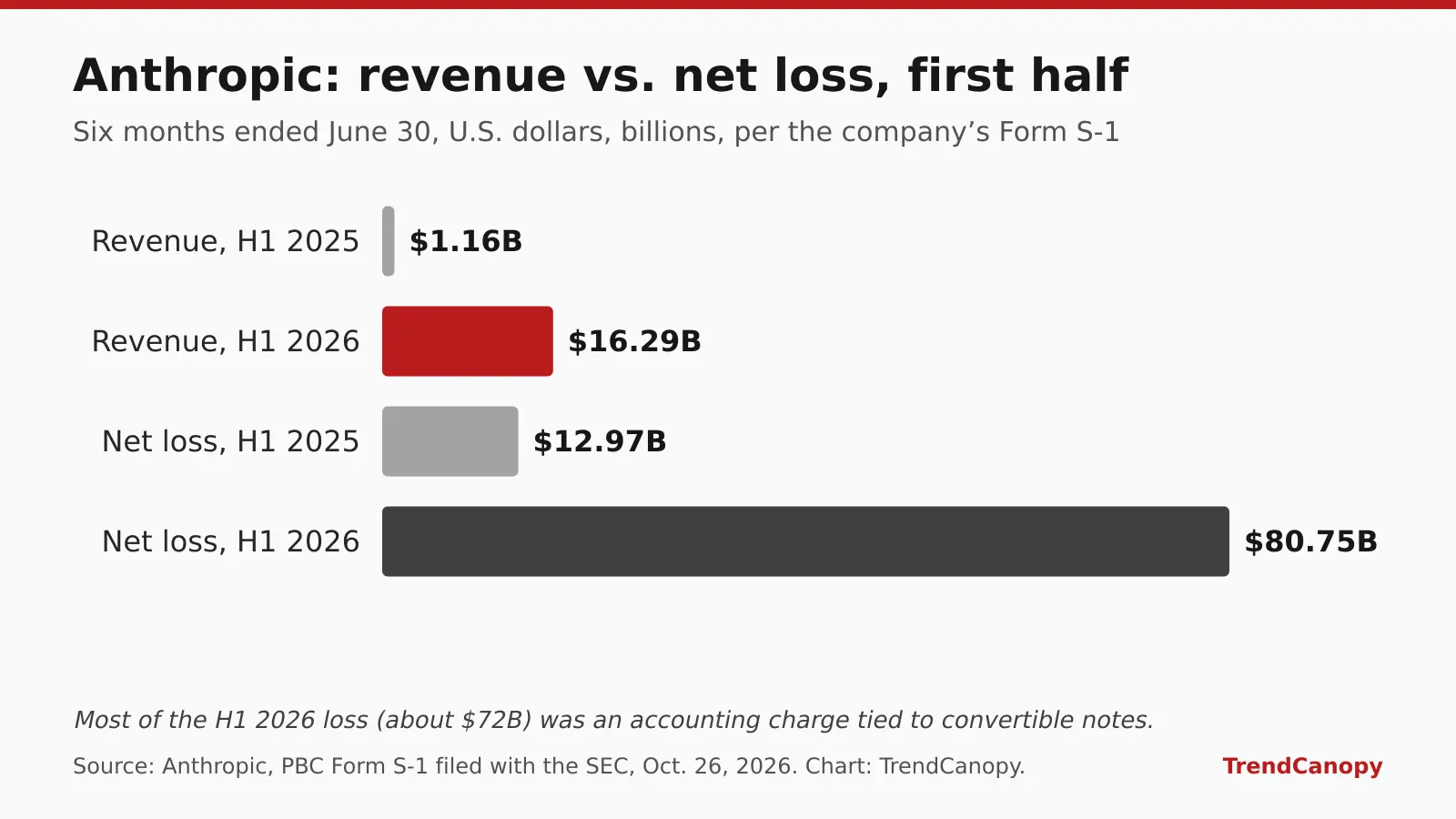
Anthropic, the company behind the Claude AI models, publicly filed a Form S-1 with the SEC on Oct. 26, 2026, for an initial public offering of Class A stock on the Nasdaq under the ticker ANT. The filing shows $16.29 billion in revenue and an $80.7 billion net loss for the first half of 2026. The share count and price range have not been set, so shares cannot be sold until the SEC declares the registration effective.
Key takeaways
- Ticker and exchange: ANT on the Nasdaq Global Select Market; Goldman Sachs and Morgan Stanley lead the underwriters.
- Revenue: $16.29 billion in the six months to June 30, 2026, up from $1.16 billion a year earlier.
- Net loss: $80.7 billion in the same period, most of it (about $72 billion) an accounting charge tied to convertible notes, per CNBC.
- Compute: multi-year commitments include up to $120.5 billion with SpaceX, $114.5 billion with Google and $110 billion with Amazon.
- Control: a co-founder entity will hold 50.1% of voting power, and a trust elects a board majority.
In this article
Anthropic, the San Francisco AI company that makes the Claude family of models, is officially on the path to becoming a public company. On Monday, Oct. 26, 2026, it announced that it had filed a registration statement on Form S-1 with the U.S. Securities and Exchange Commission for a proposed initial public offering (IPO) of its Class A common stock. The filing on SEC EDGAR gives the public its first full look at the company's finances. Below are the numbers and details that matter most, in plain English.
Not investment advice. This article explains what the public filing says. It is not a recommendation to buy or sell any security.
What we know about the Anthropic IPO
- Ticker: ANT, on the Nasdaq Global Select Market.
- Price and size: Not yet set. Anthropic said the number of shares and the price range "have not yet been determined."
- Banks: Goldman Sachs and Morgan Stanley are the lead underwriters, with about 20 other banks in the syndicate, CNBC reported.
- Status: The registration statement "has not yet become effective," so no shares can be sold yet.
- Background: Anthropic first filed confidentially with the SEC in June, which let regulators review its financials before they were made public, according to CNBC.
What is an S-1? It is the registration statement a company files with the SEC before selling stock to the public for the first time. It contains audited financial statements, a description of the business and a long list of risk factors. An IPO is the first sale of a company's stock to the public, as the SEC's Investor.gov glossary explains.
The key numbers in Anthropic's S-1
| Metric | Figure | Period |
|---|---|---|
| Revenue | $16.29 billion | Six months ended June 30, 2026 |
| Revenue a year earlier | $1.16 billion | Six months ended June 30, 2025 |
| Full-year 2025 revenue | $4.59 billion | 2025 |
| Net loss | $80.7 billion | First half of 2026 |
| Cash, equivalents and short-term investments | $131.65 billion | As of June 30, 2026 |
| Customers paying $100,000+ a year | More than 11,900 | As of Sept. 30, 2026 |
| Employees | 5,300 | As of Sept. 30, 2026 |
Sources: CNBC's S-1 coverage and the S-1 filing.
Why the loss is so large
The headline $80.7 billion loss looks alarming, but context matters. CNBC reported that roughly $72 billion of it comes from accounting charges for changes in the value of convertible notes, which rose as Anthropic's valuation increased. The Verge, citing earlier Wall Street Journal reporting, also noted that most of the loss is accounting-related.
The operating picture is different. CNBC calculated that cost of revenue was $2.38 billion against $16.29 billion of revenue in the first half, which implies a gross margin of about 85%, up from about 12% a year earlier. The filing warns margins may swing as large amounts of new computing capacity come online.
Where the revenue comes from
- Consumption-based revenue (customers paying for usage) was $13.1 billion, or 80% of the total, in the first half.
- Subscriptions were $3.2 billion, or 20%.
- Cloud marketplaces (Amazon Web Services, Google Cloud and Microsoft Azure) accounted for 48% of revenue in the first half of 2026.
- International revenue was $4.5 billion, about 27.8% of the total.
All four figures are from CNBC's reading of the filing. The filing also says no single customer made up more than 10% of revenue in the first nine months of 2026.
The giant compute bill
Training and running AI models needs huge amounts of computing power, and the S-1 shows how much Anthropic has committed to buy:
- SpaceX: about $3.1 billion a month for Nvidia GPU capacity once fully delivered, up to $120.5 billion through 2029.
- Google: at least $114.5 billion for TPU chips through 2033.
- Amazon: $110 billion for cloud services and Trainium chips through 2036.
- Microsoft: at least $44.9 billion between November 2026 and May 2033.
These commitments were reported by The Verge and CNBC. The company warns that if it cannot secure enough compute, it risks "falling behind the technological frontier."
Who will control Anthropic after the IPO
Anthropic is a public benefit corporation (PBC): a for-profit company that must, under Delaware law, balance shareholder returns with a stated public benefit. For Anthropic, that purpose is "the responsible development and maintenance of advanced AI for the long-term benefit of humanity," according to the prospectus.
Its share structure is unusual:
- Class A: the shares sold to the public, with one vote each.
- Class F: a single share held by a "Founder LLC" of the seven co-founders, including CEO Dario Amodei and President Daniela Amodei. It carries 50.1% of total voting power on most shareholder votes.
- Class T: held by the Long-Term Benefit Trust, which elects directors who make up a majority of the board.
Anthropic itself says this structure "has no direct public company precedent" and could make it harder to replace directors or for shareholders to receive a takeover premium, CNBC reported.
Risks the filing highlights
The S-1 includes more than 90 pages of risk factors. Among them:
- Competition from OpenAI and Google, the only two competitors named.
- Government disputes, including a Pentagon "supply chain risk" designation that is still being litigated.
- Supply chain dependence on TSMC in Taiwan for advanced chips.
- Data center moratoriums being considered in some U.S. states.
- AI safety and misuse, including the risk that safeguards fail.
What's next
- Price range. Anthropic will amend its filing to set the number of shares and a price range.
- Roadshow. Executives pitch the offering to investors. The Information reported the roadshow could start in about two weeks, with a listing targeted for the week of Nov. 16. Anthropic has not confirmed a date.
- SEC effectiveness and pricing. Only after the SEC declares the registration effective can the IPO be priced and shares begin trading under ANT.
The timing comes as investors debate AI spending. For more on the money side of the trends Americans are following, see our Money section and Tech coverage, and catch up on the 2026 midterm elections.
The bottom line
Anthropic's S-1 shows a business whose revenue has grown roughly fourteenfold in a year, a very large accounting-driven loss, hundreds of billions of dollars in computing commitments and a governance structure that keeps control with its founders and a safety-focused trust. The final price, size and date are still unknown.
Frequently asked questions
- What is Anthropic's stock ticker?
- Anthropic has applied to list its Class A common stock on the Nasdaq Global Select Market under the symbol ANT. The shares are not trading yet.
- When will Anthropic go public?
- No date has been announced. Anthropic filed its public S-1 on Oct. 26, 2026; the IPO can happen only after the SEC declares the registration statement effective and the price is set. The Information reported the company is targeting the week of Nov. 16, which Anthropic has not confirmed.
- How much revenue does Anthropic make?
- Anthropic reported $16.29 billion in revenue for the six months ended June 30, 2026, compared with $1.16 billion in the first half of 2025, and $4.59 billion for all of 2025.
- Why did Anthropic lose $80.7 billion?
- According to CNBC's reading of the filing, about $72 billion of the first-half 2026 net loss came from accounting charges for changes in the value of convertible notes as the company's valuation rose, rather than from day-to-day operating costs.
- What is an S-1 filing?
- A Form S-1 is the registration statement a company files with the U.S. Securities and Exchange Commission to sell shares to the public for the first time. It includes audited financial statements, risk factors and details of the offering.
Sources
- Anthropic files S-1 with the SEC for proposed initial public offering · Anthropic, Oct. 26, 2026
- Anthropic, PBC, Form S-1 registration statement · U.S. Securities and Exchange Commission (EDGAR), Oct. 26, 2026
- Anthropic's IPO plans: Record losses, AI risks and growth potential outlined in the S-1 · CNBC, Oct. 26, 2026
- Anthropic's IPO filing lays out a plan to 'revolutionize every area of human endeavor' with AI · The Verge, Oct. 26, 2026
- Anthropic's S-1 takeaways · The Information (subscription), Oct. 26, 2026
- Initial public offering (IPO), glossary · Investor.gov (U.S. SEC)

About the author
Editorial team
The TrendCanopy editorial team researches what Americans are searching for, checks the facts against primary sources and publishes clear, sourced explainers.
Spotted an error? Read our corrections policy or contact us. Last reviewed October 26, 2026.
Related stories
Microsoft Buyouts: 60,000 Employees Offered Voluntary Exit
Microsoft is offering voluntary buyouts to about 60,000 employees, roughly 27% of its workforce. Who's eligible, what the offers include and the deadlines.
OpenAI GPT-6.1 Terra: What's New, Price and Who Gets It
OpenAI's GPT-6.1 Terra is a faster, cheaper model built for computer use, visual reasoning and writing. Benchmarks, API pricing and availability explained.
Student Loan Debt Collection: What Borrowers Should Know
Reports say collections on defaulted federal student loans could restart, which the Education Department disputes. What's official and what to do.